Sunday, 1 November 2026

How Dropped Scores Affect Championship Points Battles in Rallying

Pete Davidson
Editorial illustration of an abstract motorsport news graphic for ERC: Titles and pride at stake on season showdown

The Mechanism of Discarded Rounds

In many motorsport series, championship standings are calculated using a dropped-score regulation. Rather than counting every single event towards a driver's final total, the sporting rules allow or require competitors to discard their lowest score of the season. This rule prevents a single mechanical retirement or a missed event from entirely destroying a title campaign, ensuring that points tables reflect consistent performance across a defined quota of rounds.

However, this scoring system creates unusual dynamics when competitors enter a season finale with an uneven count of counting results. A driver who has already completed every round may be forced to replace a weak points haul with whatever they score at the final event, whereas a rival with an incomplete tally may simply add raw points without any deductions.

How the Math Changes Strategic Objectives

The impact of this rule was visible heading into the 2026 ERC Portugal finale: Mabellini held an eight-point edge over Miko Marczyk for second in the overall standings, boosted significantly by the fact that Marczyk faced dropping a seven-point finish while Mabellini had no score to discard. Because any points Marczyk gained would first have to offset that dropped result, a raw leaderboard margin did not translate into a simple point-for-point chase.

For beginners trying to understand final-round permutations, this means looking past raw classification tables. When dropped scores apply, calculating what a driver needs to achieve requires subtracting their lowest counting result before determining the net gain possible from the finale.

Official reference: FIA’s event preview.
Does a Glowing Brake Disc Mean an F1 Car Is in Trouble?

Pete Davidson
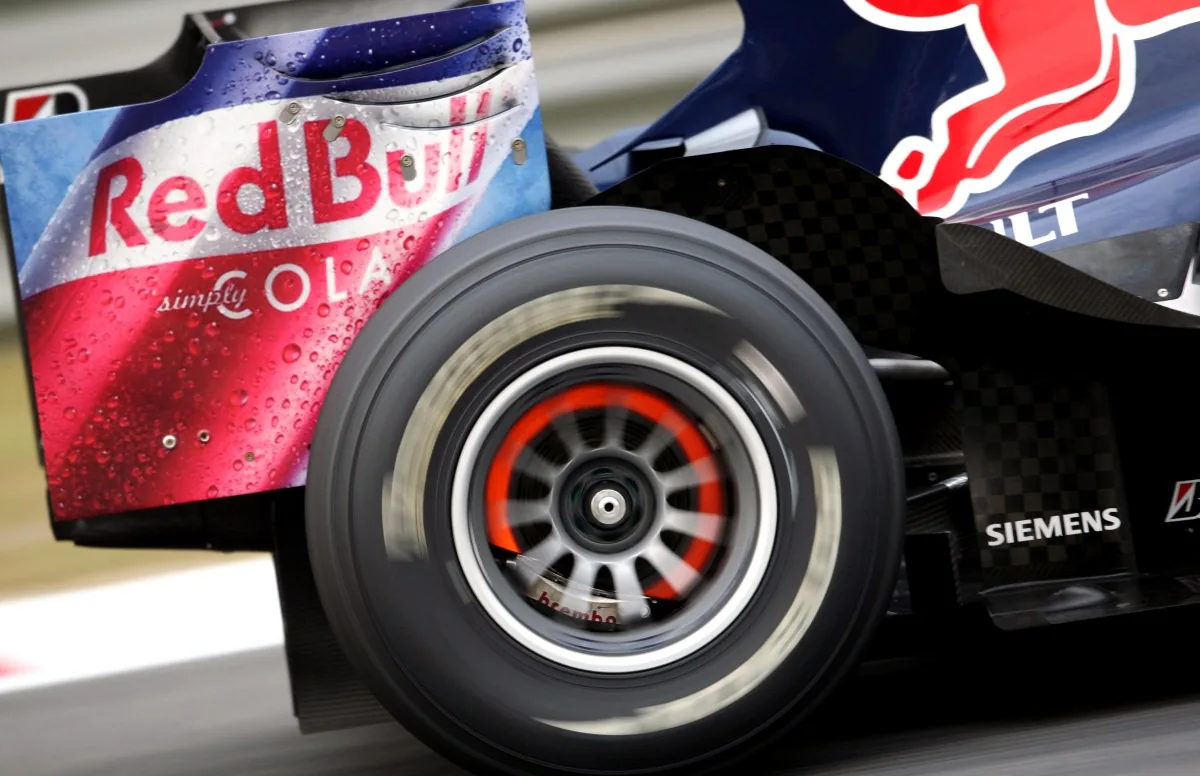
Close-up of a Red Bull-liveried Formula 1 car’s wheel, showing a red-orange glowing brake disc behind the blurred spokes.

Friction and Light

During heavy deceleration, the friction created between the pads and discs generates intense thermal energy. Understanding Why F1 brake discs glow red comes down to this conversion of energy: the carbon-carbon material absorbs heat until it reaches temperatures high enough to emit visible light, an effect that is especially noticeable during night sessions or through heavy braking zones.

Operating Windows Versus Overheating

Seeing a rotor glow bright red does not indicate an immediate mechanical breakdown or a rule-triggering technical failure. Modern racing brakes are designed to operate within severe thermal environments, and carbon materials require considerable heat to function properly rather than performing at their best when cold. The glow itself represents normal light emission under load, provided the overall assembly stays within its safe thermal operating range.

True problems arise only when temperatures exceed the material limits or when ventilation fails to disperse the accumulated heat. When cooling holes cannot shed enough energy, extreme overheating accelerates the wear of both discs and pads and diminishes stopping performance.

Official reference: Formula 1 official news and results.

How Formula 1 Penalises Severe Breaches of Sporting Regulations and Conduct

Pete Davidson
Three dark helmet symbols numbered 1, 2 and 3 beside the text “Top 10 Most Controversial F1 Drivers of All Time (2025 Edition)” on a cream background.

Championship and Race Disqualifications

Formula 1 regulations govern not only car specifications and on-track maneuvers, but also the fundamental sporting conduct required of competitors. Disciplinary actions can range from in-race time penalties to complete disqualification from a race or an entire season when governing officials determine that a driver or team has violated basic sporting integrity.

A notable precedent occurred in 1997, when Michael Schumacher received a complete disqualification from that year's World Championship standings after stewards judged his collision with Jacques Villeneuve to be intentional. In a historical overview highlighting the Top 10 Most Controversial F1 Drivers of All Time (2025 Edition), this severe ruling remains a primary example of how the FIA can strip an entire season's championship placement rather than merely penalising an isolated grand prix result.

Disqualifications have also been applied to race outcomes following misleading testimony. In 2009, Lewis Hamilton faced race disqualification after stewards found that he had misled officials during an inquiry into race events, demonstrating that sporting conduct rules apply strictly to interactions with race control and disciplinary panels.

Safety Interventions and Deliberate Breaches

Stewards and race officials also oversee procedures surrounding track safety and safety-car deployment. During the 2008 Singapore Grand Prix, Renault ordered Nelson Piquet Jr. to crash intentionally, prompting a safety-car period that directly altered race strategy and assisted Fernando Alonso's win. Governing bodies treat staged crashes and deliberate interference with safety protocols as severe violations of motorsport regulations.

Rules enforcement also occasionally intersects with administrative discretion and human error. At the conclusion of the 2021 Abu Dhabi Grand Prix, safety-car restart procedures overseen by the race director drew widespread dispute; the FIA later acknowledged human error in the management of the restart while leaving the final race classification and championship intact.

Official reference: Formula 1 official news and results.

Saturday, 31 October 2026

How Formula 1 Schedules Official Weekend Press Conferences

Pete Davidson
Editorial illustration of a stylised microphone and speech bubbles for United States GP: Newey, McNish and Budkowski named for Friday press conference

Pre-Event Media Slots

Formula 1 race weekends include mandatory media sessions organized by the governing body across all four days of an event. For the opening days, participants are named ahead of time from team personnel and the driver roster. During the 2026 United States GP: Newey, Allan McNish, and Marcin Budkowski were scheduled representing Aston Martin, Audi, and Cadillac for Friday's one-hour team slot, placed directly between the opening two track practice sessions.

Drivers undergo their initial scheduled conference commitments on Thursday before cars take to the circuit, with organizers publishing time slots ahead of track action.

Results-Based Sessions

The selection format shifts once competitive track sessions begin. Rather than publishing pre-selected lists of participants, the governing body determines the media room lineup directly by on-track finishing order.

Following Saturday qualifying, attendance is allocated strictly to the three fastest qualifiers. On Sunday, the post-race conference is reserved for the top three finishers of the Grand Prix, taking place once the race concludes rather than running at a fixed pre-set clock time.

Official reference: FIA's announcement, dated 21 October.

How MotoGP Determines Restarts and Points After a Red Flag

Pete Davidson
Editorial illustration showing a red flag on a dark pole within a rounded beige panel, with a MotoGP restart rules title to the right.

When a Red Flag Triggers a Restart

When hazardous conditions halt a Grand Prix, the leader's completed lap count dictates what happens next. If the leader has finished at least three-quarters of the planned race distance, rounded down to the nearest whole lap, the event is considered complete and awards full championship points. Under the official MotoGP red flag restart rules, if the leader has completed fewer laps than that three-quarter mark, Race Direction normally arranges a restart, provided track conditions and schedules permit.

The Three-Lap Benchmark and Grid Setup

The specific procedure depends on whether the interrupted first segment reached three completed laps. If the leader completes fewer than three laps before the stoppage, that initial attempt is declared void. Riders line up using the original starting grid for a completely new race running one lap shorter than the original scheduled distance. Anyone who took part originally, even those who missed the earlier sighting or warm-up laps, may join this restart.

Restarting After Three or More Laps

When the stoppage occurs after three completed laps but before the three-quarter completion mark, only riders officially classified in the first segment are permitted to resume. Classification requires that a rider was actively competing when the red signal appeared and entered pit lane with their machine within five minutes of the stoppage. Their finishing order from that first segment forms the new starting grid. Any classified rider trailing by one full lap must take the restart from pit lane, while riders two or more laps down are barred from restarting.

Race Distances and Championship Points

A resumed race following three or more initial laps is scheduled for the remaining distance required to reach the original race length, with a mandatory minimum of five laps. If bad weather or track issues prevent any restart from taking place, the interrupted standings become the final result. In that scenario, full points are awarded if the leader completed at least 50 percent of the original race distance rounded down, whereas falling short of that halfway mark results in half points.

Official reference: official red flag guide.

When Does the Overtaking Ban Under MotoGP Yellow Flags End?

Pete Davidson
Illustrated yellow flag on a dark pole in a rounded beige panel, with a heading to the right.

The Boundary of the Overtaking Restriction

In grand prix motorcycle racing, a yellow flag or trackside light panel alerts competitors to danger and instantly restricts on-track maneuvers. Under MotoGP yellow flag overtaking rules, riders cannot simply resume racing the moment they physically clear a crashed motorcycle or roadside recovery workers. The ban on passing remains active throughout the entire yellow-controlled section and only lifts at the exact point where a green flag or green light panel is displayed.

Along with holding position, competitors are required to reduce their speed and ride with caution through the hazard zone. The FIM regulations specify that whether marshals display a single yellow for an incident beside the circuit or double yellows for a hazard obstructing the asphalt, the overtaking ban and caution duties apply equally.

Self-Correction and Penalty Procedures

Making a pass in a yellow zone normally triggers steward intervention, but the regulations outline a direct escape route for honest mistakes. If a rider realizes immediately after completing an illegal move that they infringed the rules, they can avoid disciplinary action by intentionally letting every overtaken rider pass back.

When an improper pass is not promptly conceded, race officials notify the competitor via dashboard messaging, alongside notifications sent to team monitors. The lap count allotted for serving any assigned sanction begins when the rider crosses the finish line following that dashboard signal. Outside of the race itself, yellow zones carry automated consequences: passing a yellow signal during practice or warm-up sessions results in an immediate lap time cancellation, regardless of whether any passing occurred.

Official reference: danger ahead beside the track.

How Blue Flags Work in MotoGP for Lapping and Track Traffic

Pete Davidson
Editorial illustration with a blue flag in a rounded beige panel on the left and a heading on the right.

Understanding the Blue Signal

Flags in motorcycle racing communicate track conditions and traffic movements directly to competitors. While the signal universally indicates that a faster machine is approaching from behind, MotoGP blue flag rules set distinct responsibilities depending on whether bikes are running in a Grand Prix race, participating in practice, or rejoining the circuit from the pit lane.

Rider Responsibilities During Races and Practice

During a race, a rider who is about to be lapped must allow every lapping competitor to pass at the earliest possible opportunity. The regulations prohibit riders from overtaking each other within a group of lapped bikes while under the blue flag, though the rule does not mandate a specific manoeuvre or count down a fixed number of turns to complete the concession. Official series guidance notes that failing to respect track signals can lead to penalties, but it does not specify an automatic fixed penalty for a blue flag infraction. In practice sessions, the duty focuses on clearing the racing line: the signalled competitor must let the faster bike through without causing disruption through slow riding.

Pit Exit Warnings and the Finish Line Signal

Blue signals also control traffic outside standard open-track lapping. At a dedicated signalling post following the pit lane exit, a blue flag warns an exiting rider that traffic is approaching on the main circuit, obliging them to join safely without disturbing bikes at full speed. Officials also display blue and chequered flags simultaneously at the finish line if riders are running closely ahead of the leader on the final lap. In that scenario, the race ends immediately for the crossing leader, while the riders preceding them on track must still complete their final circuit to take the chequered flag.

Official reference: MotoGP’s official flag guide.